锂离子电池在循环和存储过程中会产气,造成电池体积膨胀、极片/隔膜错位以及电池极化增加,是导致电池寿命衰减甚至引发安全问题的重要原因。层状金属氧化物锂离子电池正极材料NCM,LCO,Li-rich在充电过程产气种类和机制基本一致,目前主要关注的气体种类有:O2,CO,CO2,H2等。
原位微分电化学质谱仪(上海零露DEMS)在电池测试中,可以实时检测锂离子电池、钠离子电池、金属空气电池(如Li-O2/CO2)等储能器件运行不同阶段气体生成或消耗的情况,是研究电化学反应机理,快速筛选电极材料,评价电解液分解情况的重要工具之一。
Journal of The Electrochemical Society, 2023 170 050537
O2主要来源于正极材料在充电过程中发生的结构相变和表面残余Li2CO3的分解。NCM在使用过程中存在着不可逆相转变过程, 即由层状结构转变为尖晶石相最终转变为岩盐相并析出O2,与NCM具有类似结构的LCO同样存在不可逆相变问题 ,富锂锰基正极材料在高电压状也会出现析氧问题。本文主要以NCM为例,阐述氧气析出机理。
(论文中DEMS数据由上海零露仪器设备有限公司DEMS测试)
相变过程中晶格氧(lattice oxygen,[O])从正极脱出,其具体存在形式主要有氧自由基(·O或⋅O2 − ) 和单线态氧(singlet oxygen,1 O2)两种学说模型, 以下以单线态氧模型为例(图2)。单线态1 O2处于激发态,分子能量较高,其在电解液中有4种路径释放能量:①以电子振动耦合的形式将能量转移至溶剂分子转化为三线态氧(triplet oxygen,3 O2),即空气中O2的存在形式;②与电解液中溶剂分子发生化学反应生成氧化物;③以磷光发射的形式转化为3 O2,释放出波长为 1270 nm 的光;④两分子的1 O2碰撞生成3 O2,并释放出波长为633 nm的光。4种方式中路径①占主导地位,这也是电池中O2的主要来源,其反应速率主要由溶剂的分子振动性能和介电常数决定。其次为路径②,此过程中伴随着 其他气体的产生,只有少部分的1 O2通过路径③、 ④转化为3 O2。
图2 NCM正极相变析氧以及1O2物理/化学失活的机制
(Energy Storage Science and Technology, 2023, 12(7): 2119-2133.)
(Materials Today (2018) 21, 8, 825-833)
(论文中DEMS数据由上海零露仪器设备有限公司DEMS测试)
(论文中DEMS数据由上海零露仪器设备有限公司DEMS测试)
DEMS电池应用现场照片
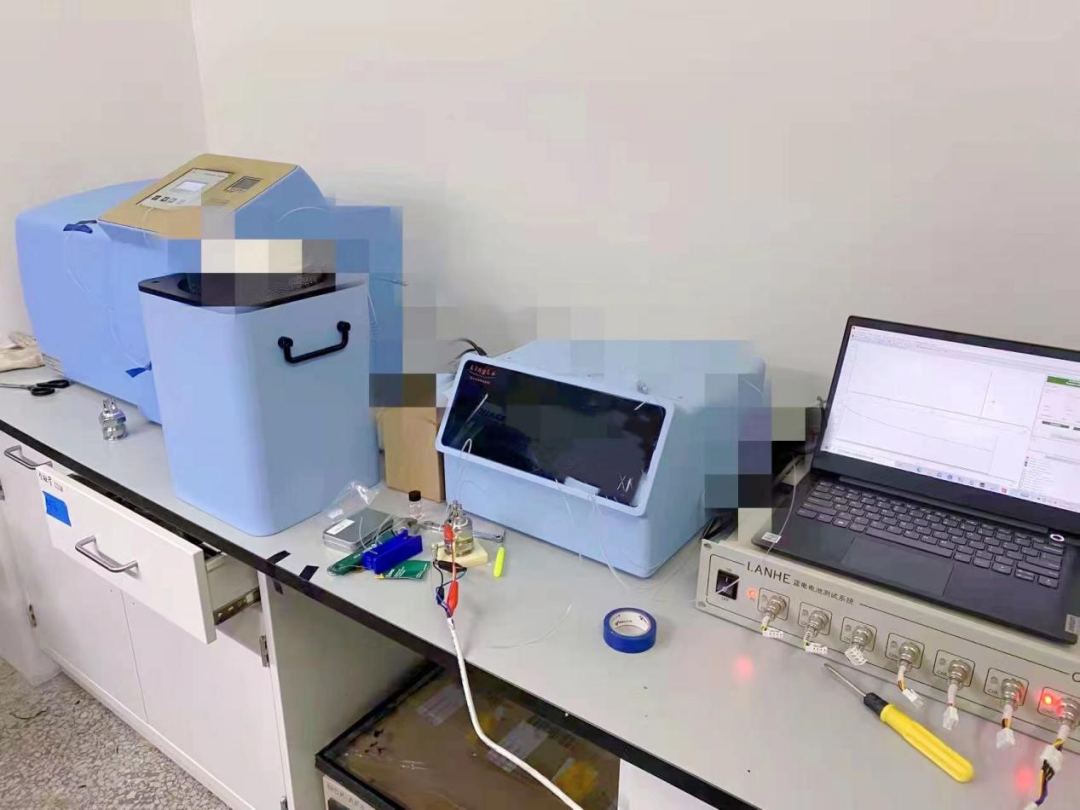
上海零露仪器设备有限公司一直致力于电化学原位质谱和电化学红外应用开发,协助客户在Nature Energy, Nature Catalysis, Nature Comm., EES, JACS, Joule, Angewa, AM,AEM等影响因子大于10期刊发表高水平论文200余篇。并将DEMS在宁德新能源(ATL),宁德时代(CATL),比亚迪,德方纳米等数众多锂电新能源企业得到商品化应用。
更多上海零露仪器公司DEMS正极材料氧气析出论文参考如下:
1.Zhan Lin*, et al. Ultra-Long Life Li-Rich Li1.2Mn0.6Ni0.2O2 Cathode by Three-in-One Surface Modification for Lithium-Ion Batteries. Angew. Chem. Int. Ed. 2020, 59, 7778-7782
2.Yong Yang*, et al.Elucidating and Mitigating the Degradation of Cationic-Anionic Redox Processes in Li1.2Mn0.4Ti0.4O2 Cation-Disordered Cathode Materials. ACS Appl. Mater. Interfaces 2019, 11, 45674-45682
3.Xiangfeng Liu*, et al. The effect of oxygen vacancy and spinel phase integration on both anionic and cationic redox in Lirich cathode materials. J. Mater. Chem. A. 2020, 8, 7733-7745
4.Xuefeng Wang*, Weifeng Wei*, et al. Regulating Anion Redox and cation migration to enhance the structural stability of Lirich layered oxides. ACS Appl. Mater.Interfaces 2021, 13, 12159-12168
5.Xiangfeng Liu*. Tuning Both Anionic and Cationic Redox Chemistry of Li-Rich Li1.2Mn0.6Ni0.2O2 via a“Three-in One”Strategy. Chem. Mater. 2020, 32, 9404-9414
6.Wei Huang, Xueliang Sun*, etal. Structure and Charge Regulation Strategy Enabling Superior Cyclability for Ni-Rich Layered Cathode Materials. Small 2021, 2104282
7.Weijin Kong, Xiangfeng Liu*, et al. Tailoring Co3d and O2p Band Centers to Inhibit Oxygen Escape for Stable 4.6 V LiCoO2 Cathodes. Angew. Chem. 2021, 133, 27308-27318
8.Weijin Kong, Xiangfeng Liu*, et al. Stabilizing the Anionic Redox in 4.6 V LiCoO2 Cathode through Adjusting Oxygen Magnetic Moment. Adv. Funct. Mater. 2022, 2202679
9.Wenzhi Wang, Xiaogang Zhang*, et al. In Situ Tuning Residual Lithium Compounds and Constructing TiO2 Coating for Surface Modification of a Nickel-Rich Cathode toward High-Energy Lithium-Ion Batteries. ACS Appl. Energy Mater. 2020, 3, 12423-12432
10.Qingyuan Li, Xiangfeng Liu*, et al. Improving the oxygen redox reversibility of Li-rich battery cathode materials via Coulombic repulsive interactions strategy. Nat Commun. 2022, 13, 1123
11.Jicheng Zhang, Xiangfeng Liu*, et al. Addressing voltage decay in Li-rich cathodes by broadening the gap between metallic and anionic bands. Nat Commun. 2021, 12, 3071
12.Zhijie Feng, Bingkun Guo*, et al. Adjusting Oxygen Redox Reaction and Structural Stability of Li- and Mn-Rich Cathodes by Zr-Ti Dual-Doping. ACS Appl. Mater. Interfaces 2022, 14, 5308−5317
13.Dong Luo, Zhan Lin*, et al. Accurate Control of Initial Coulombic Efficiency for Lithium-rich Manganese-based Layered Oxides by Surface Multicomponent Integration. Angew. Chem. Int. Ed. 2020, 59, 23061−23066
14.Shulan Mao, Yingying Lu*, et al. Outside-In Nanostructure Fabricated on LiCoO2 Surface for High-Voltage LithiumIon Batteries. Adv. Sci. 2022, 2104841
15.Ju Li*, Fuqiang Huang* et al. Stalling oxygen evolution in high-voltage cathodes by lanthurization. Nature Energy. 2023
地 址:上海市浦东新区兰嵩路555号森兰美伦A座208室
 动物拍片腹部怎么摆【译文推荐】小动物腹部x线摄影术,一文教会你如何拍摄出一张高质量的x光片!