

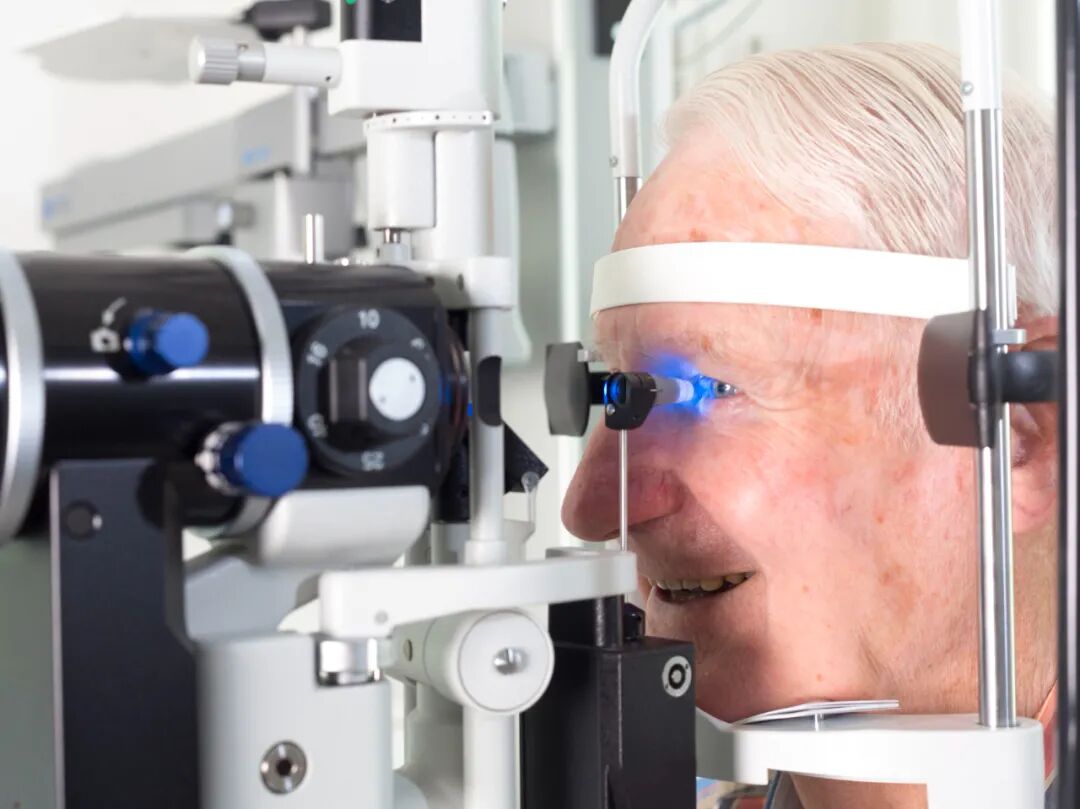
Goldmann压平眼压计的操作方法
(l)用0.5%~1%丁卡因滴眼液1~2滴点眼作表面麻醉。
(2)用消毒荧光素纸条轻轻接触被测眼下睑的内表面2~3秒后取出纸条,或滴0.25%荧光素钠滴眼液,瞬目2~3次后,使角膜表面泪膜染色,能睁眼时即可开始检查。并嘱被检者放松情绪,自由呼吸,绝不可屏住呼吸。
(3)受检者头部固定于裂隙灯下颌托上,将钴蓝色滤光玻璃置于裂隙灯光前方,被照射的泪膜呈鲜绿色,并将裂隙开至最宽,使测压头照明亮度达最大,光源投射角约为60°。
(4) 将测压头转至裂隙灯显微镜目镜正前方,采用低倍目镜并用单眼观察,让受检者向正前方直视,并尽量睁大睑裂。必要时检查者可用手指协助撑开睑裂,但绝不可加压于眼球。
(5) 将测压螺旋先转至1g刻度位置,即10mmHg压力,再将裂隙灯向前移动,使测压头接近角膜,此时检查者先用肉眼从颞侧观察角巩膜缘刚出现蓝色分光时,即可从裂隙灯目镜里观察到角膜面两个鲜绿色的荧光素反光半环,调整裂隙灯的高度,使两个荧光素半环上下对称(通常用右眼观察),继续将裂隙灯向前推移,直至观察到清晰的两个半圆形的鲜绿色的荧光素半环,微调裂隙灯的高度,使两个荧光半环上下相等,左右对称。
(6) 继续捻转测压螺旋,使上下对称的两个荧光素半环的内界刚好相接触。此时角膜压平面直径达3.06mm,记录所用重量(克)即为眼压值。如刻度为2g,眼压为20mmHg。在操作中被压平面周围的荧光素环以不宽于0.25mm为标准。如过宽则说明泪液过多,应用棉球吸去多余泪液,再行测压,否则会使测得的眼压值比实际眼压高。
(7) 如遇眼压过高,即使加压至8g仍不能使两个半圆相交,说明眼压高于>80mmHg,则需加用重力平衡杆再行测量。
(8) 重力平衡杆使用法①鉴定眼压计的准确度:操作方法为将测压螺旋转至“0”,裂隙灯之投射角为90°,将裂隙变窄,照射于测压头侧面之黑线上,然后将重力平衡杆固定,使其长端向被检者,并分别置于2g及6g重量压力的刻度线上,转动螺旋,如测压螺旋亦分别需要2g及6g重量压力时,才出现测压头的轻微摆动,则说明眼压计准确无误。②对眼压高于80mmHg者,需将重力平衡杆向检查者方向移动,根据需要置于2g或6g重量压力之刻线位置,则可测量80~140mmHg的眼压。
(9) 对角膜散光大于3D者,三棱镜与角膜接触面为椭圆形而不是圆形,必须将其弱主径线或较大的曲率半径轴置于43°轴向方位,即将测压头侧面的弱主径线轴向,对准测压头固定环的红线。因为只有在43°轴向,椭圆形的直径等于相同面积圆形的直径,方能使压平面积恰为7.35mm2。
(10) 测量完毕后,用3%双氧水溶液或1:5000洗必泰溶液擦净测压头前端,并以擦镜纸或消毒棉球拭干。

下面的英语方便大家听力训练时查找。
hello and welcome back to
learnaboutize.com in this episode we’re
going to speak about the goldmann
applianation tonometry or short get
this is a basic exam to measure the eye
and while there are of course more
easy ways to measure the eye pressure
the gold standard and has to be learned
this episode is going to be more of a
and some tips for the most common
for the first year resident if you want
to learn more about this very
how it works where it came from i’m
going to make a subsequent video
and link it up here where you can learn
about the history about the physics
how to treat special cases
all right so let’s start with the
step-by-step guide first you’re going to
want to apply an anaesthetic eye drop to
and put in some fluorescein dye some
clinics have combination eye drops which
both of these agents the anesthetic drop
so tell the patient the burning is going
to go away after about 10
seconds and give them a tissue in case
starts tearing then you’re going to take
we have single-use tips at our clinic
but if you have the original ones they
can be re-sterilized after every patient
make sure to slide it in correctly so
lines up with the white line on the
the measurement device itself is usually
mounted directly to the slit lamp
you just swing it forward until it locks
and then make sure your measurement head
is nice and straight switch your slit
and turn the brightness up as much as
you can put it at about a 45 degree
angle and then play with the light a bit
until the measurement head is nicely
now look through the eyepieces of the
note that during the whole measurement
you’re only going to see with your right
this is the first time that you can see
built into the measurement head if you
want to know more about these prisms
wait for the second more detailed video
where i’m going to tell you all about
for now all you have to do is make sure
forms a straight horizontal line
now you have to put in the expected eye
on the side of the device there is a
wheel with a lot of numbers on it
this is where you’re going to read off
the eye pressure that you measured
before you start measuring put it to the
that you’re expecting if you have no
idea what to expect put it to around 20.
once you’re happy with your settings
look back at the patient’s eye
and check whether it’s full of tears if
try them off because it’s going to give
if your patient is squinting or blinking
too much you can use a q-tip
or your fingers to open the lids but
be very careful not to push on the globe
is going to falsify your measurements
next you’re going to put the joystick of
your slit lamp all the way back
and slide the whole slit lamp forward
in direction of the patient very slowly
looking at the patient from the side not
through the slit lamp once you’re fairly
you switch over back to your eyepieces
only use the joystick to move back and
a lot of beginners struggle at this
point you can see the measurement prisms
but the patient’s eye is completely
this can be very disorienting and make
you scared that you’re going to hit the
eye too fast and hurt them so if you
have trouble orienting yourself
here’s a little tip turn down the
magnification of your slit lamp to 6.3
this allows you to see more of the
greater depth of field this way you can
safely approach the patient’s eye
and once you actually touch the cornea
you can still switch back to a 10 time
once you actually touch the cornea two
semi-circles are going to appear
they might not look perfectly centered
like this but we’re going to talk about
first let’s assume you hit it perfectly
is two semi-circles that are the same
each other on the inside of the arc do
put them straight on top of each other
so what do you do if your circles don’t
let’s go through a couple of situations
and what to do in each situation
your semicircles are very small and far
this means that the eye pressure is
higher than what you set on the machine
so you need to set it higher but please
go off the corner to do so
situation number two the two semicircles
big and overlap each other this means
that the pressure is lower than what
you’ve set on the machine
you need to go off the corner go back a
the pressure down situation number three
the two semi-circles do not have the
this means you’re not in the center of
the cornea if the top one is bigger
you have to go up if the bottom one is
bigger you have to go down
situation number four your semi-circles
are slightly off to the side and one of
them is cut off of course you have to
move to the side of the one
that is cut off but please for that also
don’t touch the cornea come off the
go over a little bit and go back on
there are a couple of ways how you can
cause yourself some problems
one of them is not touching the cornea
correctly if you touch the cornea too
the measurement is wrong if you touch
the measurements wrong there is a
range where you feel like the two
are kind of locked in you have to find
just slowly touch the cornea move
until you feel like it’s completely
locked in if you move further
you start to see movement again another
one of the problems that you’re causing
i’ve already mentioned if you’re using
your fingers or a q-tip to open the
you can apply pressure on the globe this
usually shows itself as a very volatile
that is changing every time you put the
on the eye again so if this is happening
try to lift up the lid without putting
another very common issue is too much
if your semicircles are too thick your
measurements going to be wrong
so try to dry off your patient’s eye and
another common problems are pulsations
this is when the semicircles go back and
with the heartbeat some patients just
so if you have the situation just take
that you’re measuring that was it for
this quick step-by-step guide
please comment down below if you still
have some problems if you’re still
measuring something else then your
colleagues and your superiors
i might be able to help you or some
other users might be able to help you
but please do consider all the problems
mentioned before especially the one with
not being locked in perfectly and the
and your q-tips putting pressure on the
if you’re interested in more details
pretty interesting technique i will
i will link it up here and down in the
and until then please subscribe to the
and practice as much as you can