第一作者:胡俊文1,王勇杰1
通讯作者:王林1,白瑞良2
其他作者:朱宇晗1,李寅1,陈敬寅1,张逸凡3,许多4
作者单位:1浙江大学医学院附属第二医院神经外科,2浙江大学浙江大学医学院系统神经与认知科学研究所,3浙江大学生物医学工程与仪器科学学院,4浙江大学医学院附属第二医院放射科
REF: Hu J, Wang Y, Zhu Y, et al. Preoperative Brain Functional Connectivity Improve Predictive Accuracy of Outcomes After Revascularization in Moyamoya Disease. Neurosurgery. 2023;92(2):344-352. doi:10.1227/neu.0000000000002205
PMID: 36637269 PMCID: PMC9815092

研究背景
烟雾病(MMD)是一种慢性脑缺血性疾病,既往研究发现患者的神经功能障碍和康复预后与其局灶性脑血流动力学的变化不尽一致[1],这可能是由于患者存在脑灌注以外包括脑功能重构在内的其他脑功能改变[2,3]。因此,对大脑整体功能网络的评估可能为MMD患者的临床预后研究提供更多可靠的影像指标[2]。在本研究中,我们收集了MMD患者的临床信息和术前静息态功能磁共振(fMRI)图像,并对患者进行长期随访,对比不同预后MMD患者在全局水平上的功能连接差异,将结果纳入预测模型中,观察其在预后评价中的效应。
研究方法
本研究回顾性分析了2020-2021年收治于浙医二院且在术前顺利完成静息态fMRI扫描并在随后行联合血流重建手术的烟雾病患者。我们对术后1年以上的患者进行随访,根据随访结果,将患者分为“预后良好”组和“预后未改善”组。“预后良好”定义为在随访期间无卒中或TIA复发,术前症状如感觉异常、头痛和头晕改善,或mRS评分下降。“预后未改善”定义为在随访期间出现卒中或TIA复发,术前症状持续存在或加重,或mRS评分升高。
由于既往研究提示大脑后动脉受累(PCA involvement)是MMD疾病进展的标志之一,并且与患者缺血性卒中复发的风险增加显著相关[4,5],因此,本研究也将PCA是否受累这一因素纳入到预后预测中。MMD患者PCA受累定义为MRA图像上观察到的双侧PCA狭窄或闭塞(图1)。
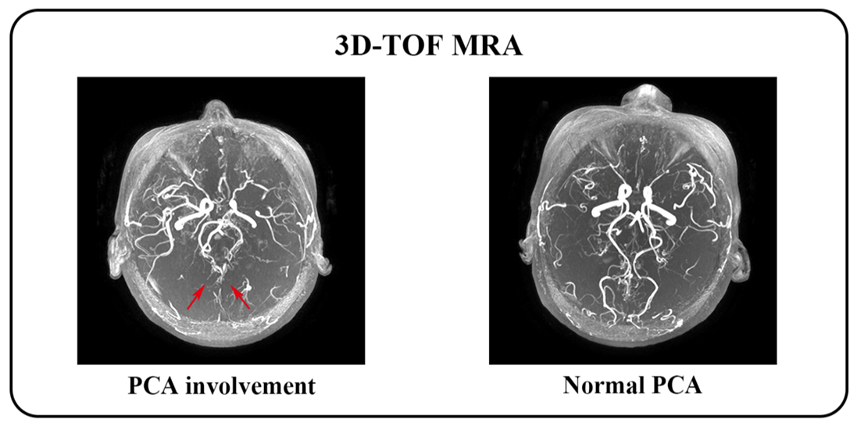
图1. 大脑后动脉受累在3D TOF MRA上的示意图。左侧为其中一位患者的MRA图像,红色箭头标注了PCA原有走行的位置,而这位患者由于双侧PCA狭窄闭塞,在MRA图像上显影不清。右侧展示了其中一位双侧PCA均显影清晰的烟雾病患者。
此外,为了排除缺血对患者脑功能连接的影响,本研究观察了每一位患者CBF图像上存在脑血流显著降低的区域,并记录低灌注区域所累及的脑叶(图2)。
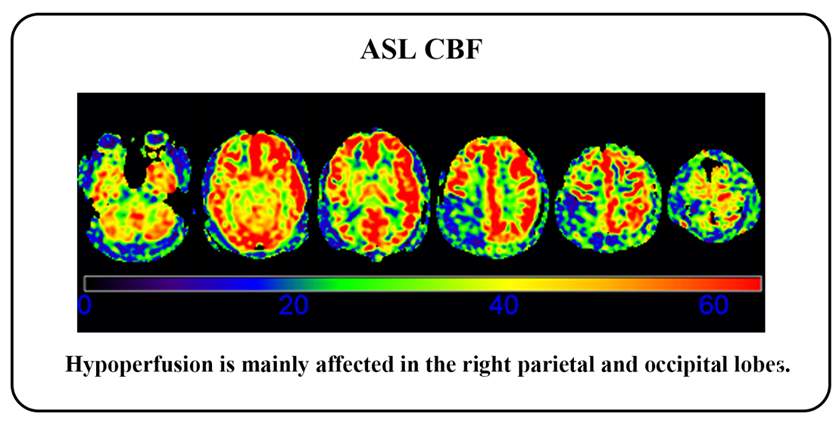
图2. 我们通过动脉自旋标记(ASL)成像得到的CBF伪彩图标记每一位患者缺血受累的脑叶,并统计其在组间的差异,以此排除因缺血累及区域的不同而导致的组间功能连接差异。通过双侧对比,可以看到该患者在右侧顶叶和枕叶部分区域出现明显的灌注下降。
随后,我们通过基于ROI分析,计算预处理完成后的fMRI图像中每一个ROI中所有体素的BOLD信号平均值,并与大脑中剩余89个ROI之间在时间序列上进行Pearson相关性分析,通过Fisher’s Z变换将相关性系数转换为Z值。最后,每位患者得到一个90×90的功能连接系数矩阵(图3)。通过组间比较得到显著差异的功能连接值,功能连接差异的阈值设置为P<0.001,并通过多重检验校正中的FDR校正(P<0.05)。
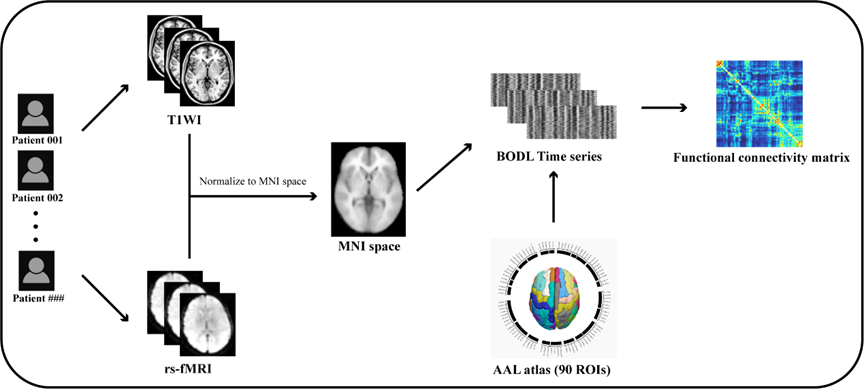
图3. 静息态fMRI的预处理和功能连接分析的简化流程示意图。将每一位患者的fMRI图像通过个体T1空间配准到MNI空间中,再计算90个脑区间BOLD信号的时序相关性,最后得到每位患者90×90的功能连接系数矩阵,并通过CONN进行可视化。
本研究使用判别函数分析来明确不同变量组合在预测MMD患者远期预后中的准确性。根据既往研究结果,本研究首先在预测模型1中纳入患者年龄、体重指数(Body mass index,BMI)、入院时的mRS评分、Suzuki分期和PCA是否受累作为变量,以测试该组合的预测准确性[6-10]。并在预测模型1的基础上加入所提取到的组间存在显著差异的功能连接指标作为预测模型2,以验证术前功能连接分析在预测患者预后中的效能。
研究结果
本研究共纳入34例MMD患者,平均年龄为46.2±8.3岁,性别比例为6:28(男:女),经过平均18.0±3.4个月的随访,最后24例患者预后良好,10例患者预后未改善。两组患者在年龄、性别、BMI、既往史、入院时mRS评分或临床表现方面等方面没有发现显著统计学差异。此外,受低灌注影响的脑叶比例在两组之间也没有显著差异,排除了因缺血影响神经元活动而导致的功能连接差异(表1)。
表1. 两组患者低灌注受累脑叶比较
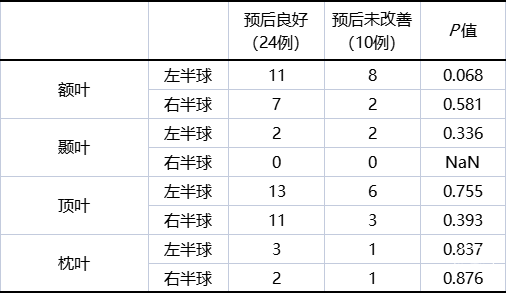
注:NaN,非数值。
功能连接分析显示两组患者在右半球扣带回后部与旁中央小叶之间的功能连接,顶上回与额中回、楔叶与扣带回中部、楔叶与楔前叶之间的半球间功能连接存在差异显著(P<0.001,FDR校正)(图4)。
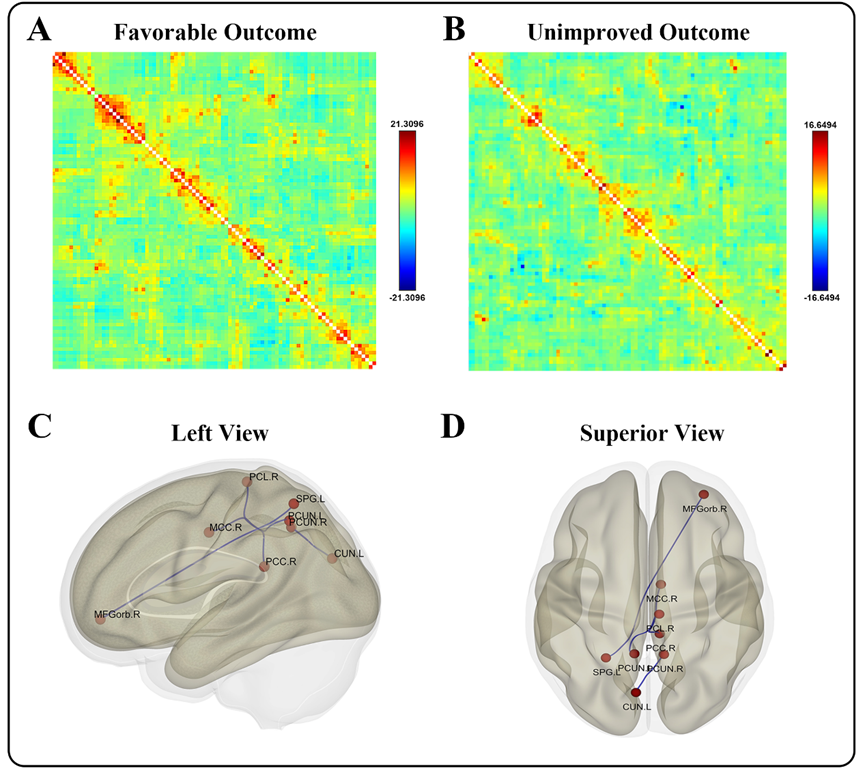
图4. A和B分别为预后良好和预后未改善两组患者组内平均后得到的90×90的功能连接系数矩阵。矩阵中的每一个体素代表X轴和Y轴对应的脑区之间的功能连接系数。越是显示红色的体素代表功能连接值越大,而越是显示蓝色的体素代表功能连接值越小。从总体上来看,预后良好组中功能连接值较大的区域要大于预后未改善组。C和D为两组间经过组间比较后得到的具有显著差异的功能连接脑区的示意图,分别为大脑左侧视和上视的三维图像。红点标注了脑区所在位置,蓝线连接的即为组间有显著差异的功能连接脑区。
判别函数模型1包含了五个变量,分别为年龄、BMI、入院时mRS评分、Suzuki分级和PCA受累,结果显示标准化典型判别函数系数分别为-0.534、0.335、0.292、0.075和0.795,其中PCA受累对预测MMD术后患者预后的判别权重最高。然而,该模型仅有64.7%的预测准确率。模型2添加了四对组间存在显著差异的功能连接配对脑区,其标准化典型判别函系数分别为0.609、0.422、0.479和0.145,最后该模型得到的预测准确率大幅提高到91.2%。此外,功能连接变量在模型2中具有更高的判别权重(表2)。因此,反映患者脑功能变化的功能连接值可以显著提高MMD术后患者远期预后预测的准确性,并且在预测结果方面相较于其他人口统计学资料和临床变量具有相对更大的重要性。
表2. 判别函数分析结果
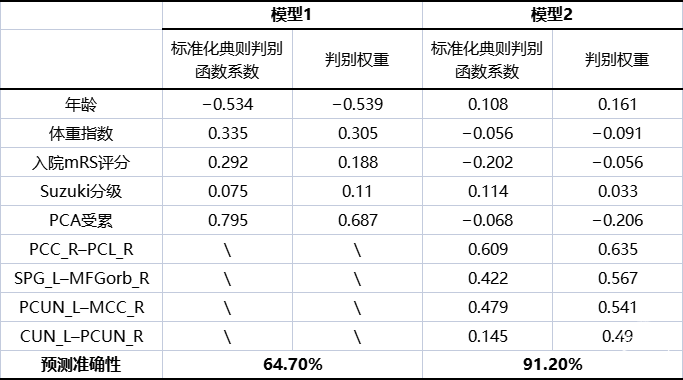
注:mRS评分,改良Rankin评分;PCA,大脑后动脉;PCC,后扣带回;PCL,中央旁小叶;SPG,顶上回;MFGorb,额中回眶部;PCUN,楔前叶;MCC,中扣带回;CUN,楔叶;L表示左半球,R表示右半球。
小 结
MMD患者术前的脑功能连接性与其血流重建术后的远期预后密切相关。基于静息态fMRI的功能连接指标,结合患者年龄、体重指数、入院时mRS评分、Suzuki分级和PCA受累情况等关键的人口统计学资料和患者临床特征信息,可以大幅提高MMD血流重建术后患者远期预后的预测能力。未来,功能连接可能成为独立于MMD血流动力学特征之外的潜在预后标志物。
参考文献
▼向上滑动阅览
通讯作者简介